Two months of anxiety. Part 2. A night of waiting. We had planned and paid in advance for a youth hostel, a room for two. When we got off the bus at the railway station, we understood that on our own on foot at 22 o’clock in the evening we would not walk and would not find this hostel.
We went up to the police, we ask, and the police are “not local people,” they politely send us to ask the local people in reflective yellow vests, the volunteers. We go up, they take us for arriving refugees and want to send us to the station to spend the night in the waiting hall. We try to explain that we are meeting Mama in the morning and will be going to Denmark. “Ah! To Denmark! And here is a bus for refugees, tomorrow it will go to Denmark, so you can spend the night here at the station.” Sensitive, responsive people, the volunteers! But we understand that we need to find a taxi and get to the hostel.
Since we had booked and paid for the hostel on the internet, it turned out they had not given an address. We show the taxi driver the name and say we looked at the GPS map, it is somewhere not far across a bridge. At last the taxi driver guesses, we ask the price, because looking at us dressed modestly for the road with rucksacks, the taxi driver does not much count on payment. We say “no problem, we will pay,” he names the price 30 zlotys and takes us into the dark, further a barrier, a dark yard and a little higher an old building (the code for opening the doors and the room they sent me by e-post).
We said goodbye, paid the taxi driver and went into the dark and a little uphill to the building where two windows were lit. We went up to the entrance door, entered the code, opened, went in, found ourselves in a foyer — no one. Room 2, we stand, enter the code, a voice in Polish: “incorrect.” A girl walks past us: “Hello!” and goes up the stairs. We stand by the room again entering the lock code and all without result. The girl comes down the stairs and offers help. She speaks English, turned out to be French.
Again we enter the code already together with the girl. At last the door is opened from inside and before us stands a sleepy fellow in underpants. Then, as you understand, a small silent scene… First my sister came to and said: “well, everything is right! This is a hostel, in the room there are three beds, our two, and the fellow occupies one.” Then I start to “resist,” that I cannot sleep with a stranger, even if he stands completely sleepy and meek and even writes the lock code; the code turned out not to be ours, but another.
Then I remember that our room is for two, that is, a separate one with two beds, and we need to ring, here are the phone numbers. The Frenchwoman dials the number and a young male sleepy voice tries to sort out our numbers; it turns out someone mixed them up and our room number is not 2 but 3 and indeed the code matched! And the fellow in underpants continued to stand as if rooted, while we were clarifying the situation. Having said politely in English to the fellow in underpants “Excuse me!” we withdrew to our two-bed room.
In the morning, for the arrival of the train at 5 o’clock, we decided to run to the station. I could not hide my agitation while we walked, ran toward the station; we did not find it at once, and in the morning there was no one to ask. At last we came: “one thought, how is Mama, did she arrive?”, in the eighth carriage, 15 hours on the road, only sitting places. We ran onto the platform, I stand by an iron fence, look at the arriving people, search with my eyes for Mama — I do not see her. My sister ran to the customs officers and volunteers to ask. It turns out they let people out by carriages, from the eighth people have not yet come out, but the volunteers have already warned customs that a woman of 95, alone, unaccompanied, is in the eighth carriage, with a Ukrainian passport.
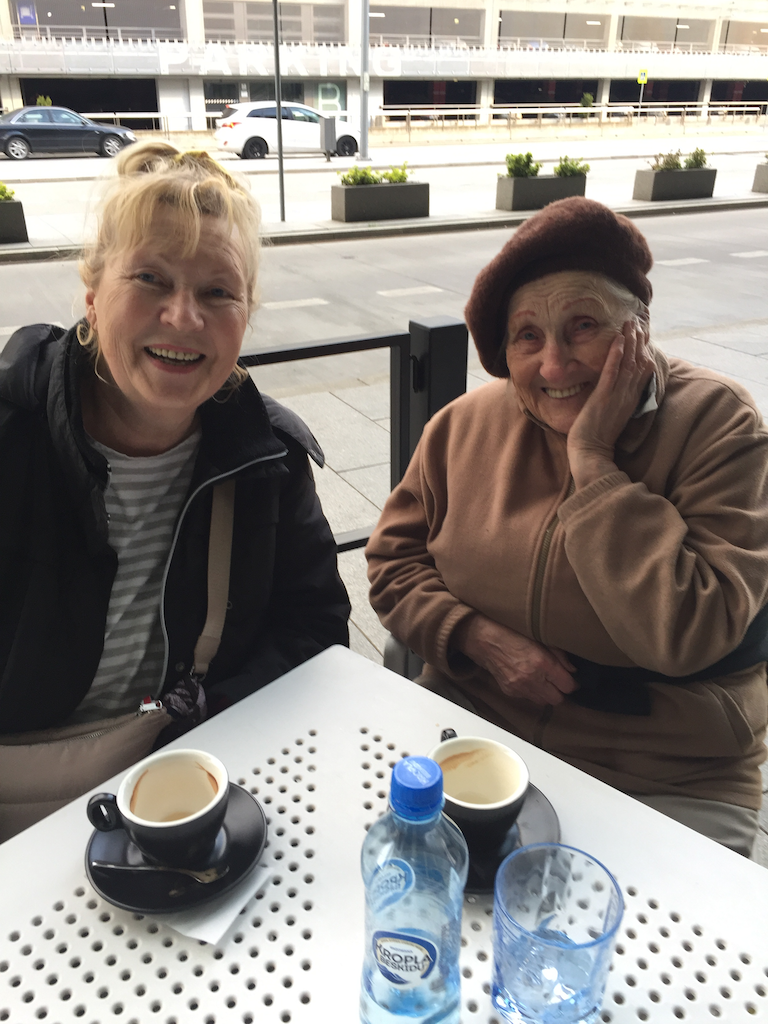
I continue to stand by the fence in the hope of seeing Mama, time stretches, a lump in the throat, I am not in control of myself. I want to write a great deal of positive about the organisation of receiving people in Poland. Early in the morning in the street there is a buffet with fresh hot food, tables, benches with warm blankets. The newly arrived can at once eat, drink coffee, tea, water. The volunteers work clearly, in concert, calmly. And I stood and waited. My sister called me, I turn — Mama! After all, while there are parents, we remain children, even if I will soon turn my seventh decade, and when there are no parents, we are orphans.